Paul
Quo VadisPaul of Tarsus is a Christian apostle whose teaching brings Christian belief into direct conversation with Roman power and elite life. After Vinicius asks the Christians to guide him, Paul agrees to accompany him to Antium; there, through instruction and debate, he helps the young tribune approach a new faith and gives the novel a voice for comparing Christian ethics with Rome’s anxieties and social conventions.
Identity and Arrival in Rome
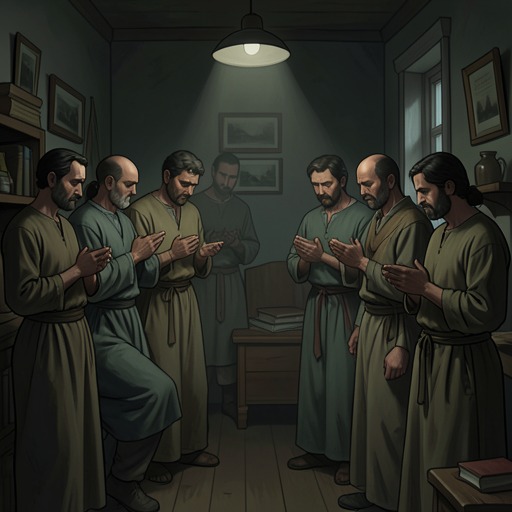
Paul is introduced to Vinicius through Chilo, who reports that the apostle is in Rome, imprisoned following charges brought by the Jews. Chilo also anticipates the arrival of Peter, the leading Christian teacher, and expects that gatherings around him will allow Vinicius to search for Lygia. The Christians’ meetings take place under conditions of caution: Vinicius wonders why they assemble secretly when Jewish worship is conducted openly in the Trans-Tiber district, and Chilo explains that Christians face hostility from both Jews and the wider population, which accuses them of crimes. This account places Paul within a community whose public exposure carries risk, even as its teachings draw new listeners.
Paul’s influence is not confined to the hidden gatherings. When Vinicius asks Peter and the assembled Christians what they bring to the world, Peter answers that they bring love, and Paul develops the answer by invoking the insufficiency of eloquence without love. Peter then blesses Vinicius and his love, recognizing the sincerity of his search. Vinicius responds by honoring the apostle and asking the Christians to accompany him to Antium, where he must go with Nero’s retinue. The proposed journey would bring Christian teaching close to the imperial court rather than leave it only among those already within the community.
Teacher and Companion to Vinicius
Peter cannot leave Rome because he serves a large Christian community, so Paul accepts the responsibility of traveling with Vinicius. He has recently been in Aricium and Fregellae and is preparing for a longer journey eastward to visit churches and renew their zeal; despite that broader work, he agrees to help Vinicius. His willingness to go reflects the Christians’ readiness to travel far for an individual soul, a principle the narrative sets against the Roman world’s hierarchies of status and influence.
In Antium, Paul teaches among Vinicius’s household. Vinicius reports that people there quickly gather around the apostle, regarding him as a wonder-worker and an almost supernatural figure. When asked what he is doing, Paul describes his work as sowing: an image of teaching as patient cultivation rather than command. His presence also attracts the interest of Petronius and Seneca, who hear of him through Gallo. The report emphasizes that Paul’s reach extends beyond new converts, drawing the attention of prominent Romans who remain uncertain about Christianity.
Paul’s guidance intersects with Vinicius’s relationship with Lygia. Vinicius tells her that Paul will spend his days and nights in Antium teaching him, and frames the doctrine as especially compelling because it is the faith she professes. He asks Peter for permission to see Lygia and seek her answer to a possible marriage, preferring the apostle’s mediation to an uninvited approach. Peter agrees that this is a proper joy. Paul’s teaching thus accompanies Vinicius’s effort to imagine love not as possession, but as a relationship that must be reconciled with Lygia’s beliefs and consent.
Argument with Petronius
Paul’s teaching is tested in a conversation with Petronius, who treats the subject playfully and questions why he should accept a religion that might diminish life’s beauty. Paul answers by challenging the assumption that Roman life is secure or free of anxiety. Even the wealthy and powerful, he argues, cannot know whether they will wake to a death sentence. The fear of losing pleasure, then, does not protect anyone from political danger; a society shaped by love and justice could make life more secure as well as more humane.
Paul also turns Petronius’s admiration for beauty into an argument about moral choice. Rome, he observes, has built temples and statues for divinities represented as revengeful, adulterous, and unfaithful. Paul asks what Romans might create in honor of a God of truth and mercy. He contrasts the security offered by Christian conduct with the instability of Roman family life: children may be abandoned, while marital fidelity is treated as unusual. In his account, Christian commitments bind parents and spouses to obligations that wealth and social position cannot guarantee. The argument does not simply oppose religion to aesthetic pleasure; it asks whether beauty and happiness can endure when the people and institutions surrounding them are unreliable.
The exchange also places Petronius’s circumstances within Paul’s broader moral case. A man from a powerful family might, by chance, have been poor and abandoned; in that condition, Paul suggests, the care promised by a Christian community would matter more than inherited rank. His reasoning repeatedly moves from Petronius’s privilege to the vulnerability that privilege cannot eliminate. The Christian ethic is presented as a practical alternative to a society in which neither rulers nor family relationships offer dependable protection.
Faith, Empire, and Narrative Role
Paul’s teaching reaches into the political question of who may claim divine authority. Nero asks whether Jewish priests refuse to call him a god, and they answer that their law forbids them to do so, even when refusal risks death. In a separate exchange, Nero observes that a speaker’s faith has not prevented him from calling the emperor a god; the speaker replies that he believes in Nero and hates Christians for their rejection of that faith. These episodes frame Christian belief within the coercive expectations of imperial worship, though Paul’s recorded arguments focus on love, justice, mercy, and the insecurity produced by Roman power.
Paul’s role is both practical and interpretive. He travels to help a single prospective convert, teaches in the orbit of Nero’s court, and confronts an influential skeptic without reducing the dispute to a contest over status. His image of sowing casts conversion as gradual work, while his argument with Petronius tests Roman claims to beauty and security against the vulnerabilities of ordinary life. Through Paul, the novel presents Christianity not as withdrawal from the world but as a moral challenge to its violence, social abandonment, unstable authority, and demands for emperor worship. The evidence here follows his teaching and influence; it does not establish his eventual fate.